BCDC’s BAM Range: Accelerating Innovation
Jade Williams ’25 ’27
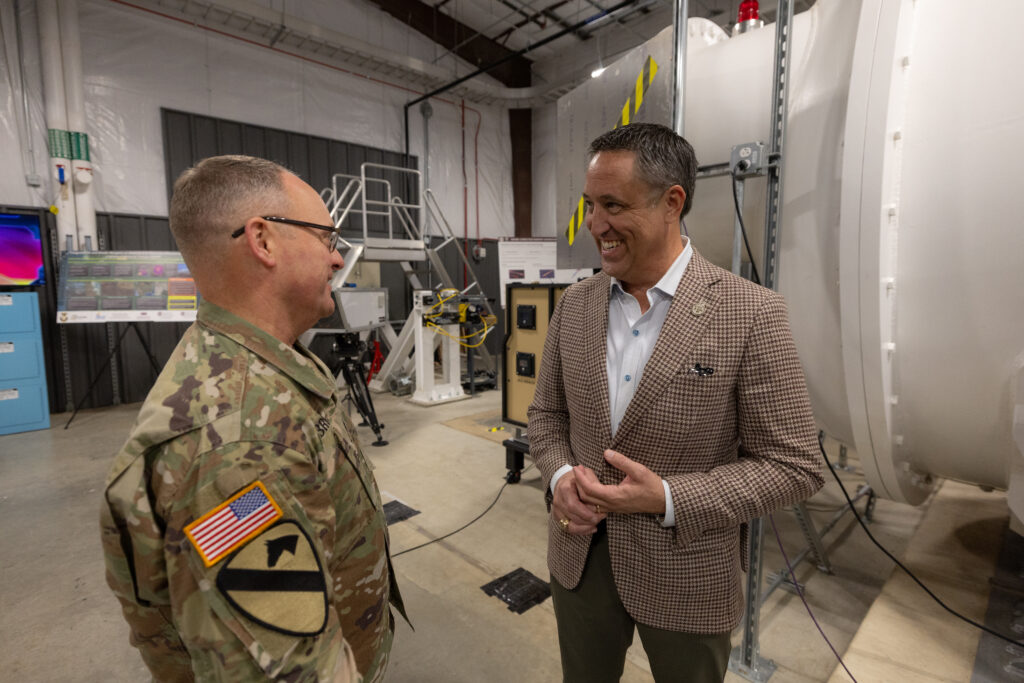
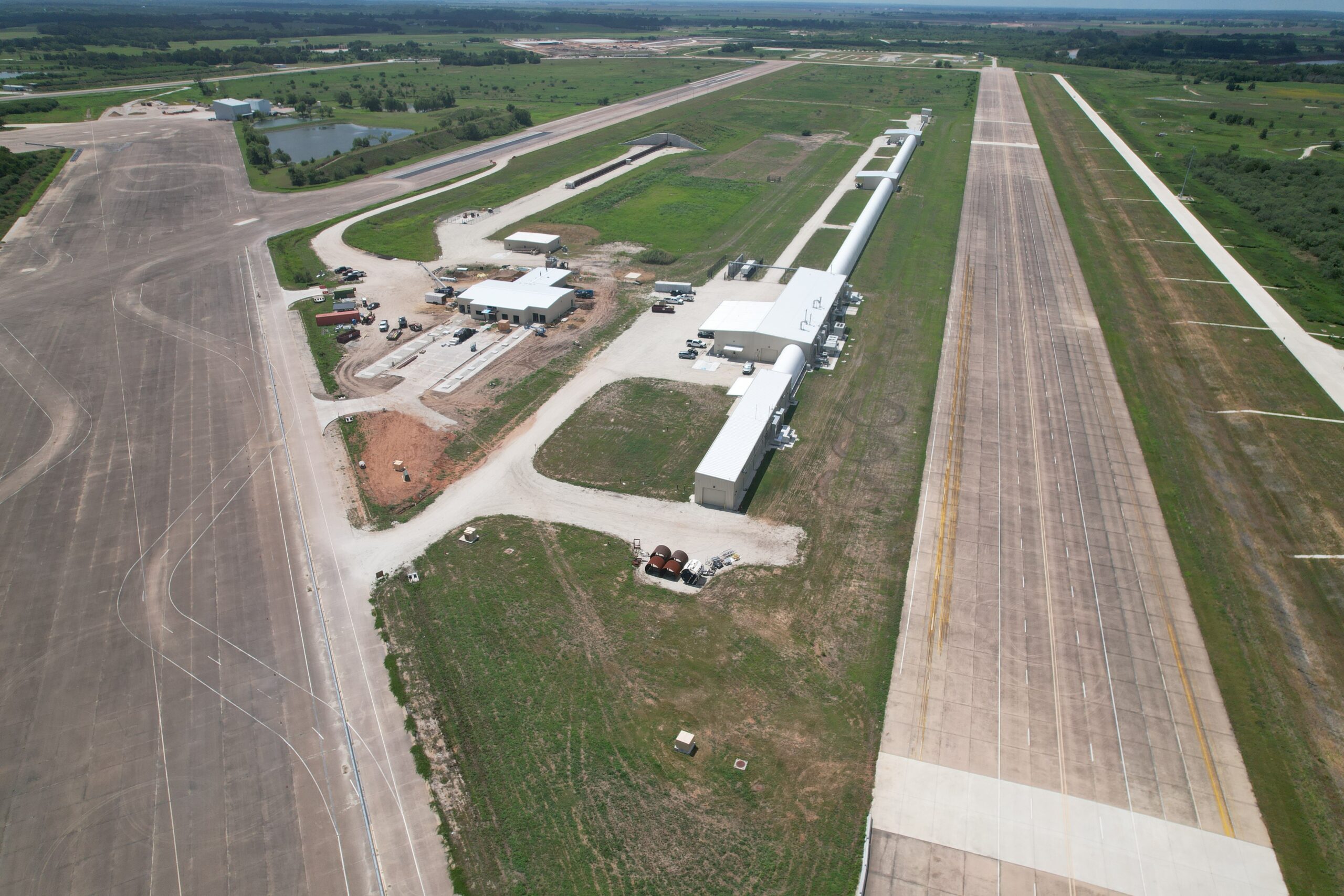
Hidden at the back of the 3,000-acre RELLIS Campus in Bryan, Texas, is a little-known facility doing big things for its country, state, and community: the BAM facility at the George H.W. Bush Combat Development Complex.
BAM, which sounds like an exclamation out of your favorite childhood comic book, is an acronym for Ballistic, Aero-optic, and Materials Range—a national-scale, fully enclosed research, experimentation, and test facility.
Specifically engineered to advance hypersonics, directed energy, and hypervelocity impact research, the BAM Range bridges the gap between lab-scale experiments and open-range testing. Since the facility’s official opening in April 2025, our employees and partners have been thinking bigger and moving faster, using software and expertise from industry, academia, and national laboratories across the country, alongside computational fluid dynamics, structural analysis, hydrocodes, and other advanced tools to develop and test the latest technologies—from hypersonic systems to high-energy lasers—to equip the warfighter.
But while BAM officially opened its doors in 2025, the facility has been an integral part of BCDC since the beginning.
Dr. Nathan Tichenor, Chief Research Officer and Director of Hypersonic Facilities, recalls:
“It started as a napkin sketch at the end of 2019, as BCDC itself was standing up. We executed our first shot at the end of 2024, about five years from concept to operation. We built through COVID and a 16-month delay procuring our two-stage light gas gun. Even with those headwinds, we stood up a large-scale T&E-class facility faster than the federal government typically can. That speed is a real value we bring to the government and our partners.”
That speed and efficiency continue to be hallmarks of BAM and BCDC—and part of what keeps partners coming back to the facility.
Inside the 2.4-meter-diameter enclosed range, researchers have an unprecedented level of control over the conditions that can affect a test. From high-energy lasers (HEL) to hypersonic systems, BAM allows researchers to control the environment and precisely measure how materials and systems respond.
Its controllable atmosphere and integrated instrumentation enable researchers to conduct experiments under simulated weather conditions, including turbulence, precipitation, and particulates, allowing them to explore real-world effects in a repeatable and secure environment.
Hypersonics
Hypersonic means speeds above Mach 5. This is more than five times the speed of sound, or roughly a mile per second. At these speeds, air does not behave the way it does at lower velocities. Friction with the atmosphere generates extreme heat, while the physics of how air flows around a vehicle fundamentally changes.
“It is one of the most demanding and complex physics environments in aerospace, and relatively few places in the country can test in this regime. Texas A&M is uniquely positioned to do so.
Between BAM and the university’s broader suite of hypersonic wind tunnel facilities, we give researchers and defense partners real access to this regime, not just simulations on paper,” states Dr. Tichenor.
High-Energy Lasers
High-energy laser (HEL) directed energy uses concentrated electromagnetic energy as the effect rather than a physical projectile. Instead of firing a traditional munition at a target, a laser propagates energy through the atmosphere and interacts with the target material once it arrives.
That creates a host of challenging physics, from understanding how a laser propagates through the atmosphere to determining how energy interacts with a target.

At BAM, researchers can explore those effects using operationally relevant systems and materials at realistic distances, within a controlled environment where atmospheric and test conditions can be precisely characterized. BAM’s capabilities can also be complemented by outdoor testing at RELLIS and partner ranges to validate results under real-world conditions.
Hypervelocity Impact
Hypervelocity impact research examines what happens when objects collide at extremely high speeds. At these velocities, materials can behave very differently than they do under ordinary conditions, momentarily responding more like fluids than conventional solids.
Understanding these interactions has applications in both national security and civilian research, ranging from fundamental materials science and equations of state to overall system performance.
At BAM, researchers can study these interactions in a controlled environment, providing insight into how real materials behave under extreme conditions and the examples given above are just a few of the capabilities available at the BAM facility for testing as well as research and development.
Bridging the Gap
Despite its cold, somewhat monotone exterior, BAM is a modern-day necessity for conducting critical national research and experimentation faster and more efficiently—and it is doing so right in Texas A&M University’s backyard with help from key partners like the Texas A&M University System and the U.S. Army.
Its size, enclosed environment, and integrated diagnostics allow researchers to replicate and measure phenomena that can be difficult to capture through traditional wind tunnels, outdoor ranges, or modeling along with technology not available anywhere else in Texas, or other parts of the nation supplying critical needs.
Tichenor describes BAM as occupying a unique position between the laboratory and the open range.
“BAM occupies a strategic middle ground that does not really exist anywhere else. Lab-scale experiments are precise but limited. You are often studying isolated phenomena at small scale. Open-range testing gives you realism, but at enormous cost, with limited instrumentation control, weather dependency, and scheduling that can take months or years to arrange through federal facilities.
“BAM is an enclosed, long-path, defense-grade test environment that gives researchers and defense partners something in between: near-open-range realism combined with laboratory-grade precision, repeatability, and control. It is the only range of its kind on a U.S. public university campus, and it is the largest and most instrumented facility of its kind in the country.
“We can characterize our test environment down to fine detail and run tests back-to-back without waiting on weather windows or range schedules. That lets us iterate at a speed neither a benchtop lab nor a national range can match.”
By combining controlled testing with advanced computational tools and complementary outdoor ranges, as well as the minds to research available at BCDC, BAM helps researchers move technologies from concepts and simulations toward real-world performance.
And the capabilities are only getting started.
Going the Distance
BAM Phase II is currently underway, making the total length of the range one km, with completion expected within the next two years. The effort is a joint investment between the Army, which is providing federal funding, and The Texas A&M University System, which is providing the infrastructure.
Once complete, the extended range will support additional infrastructure for high-energy laser and hypersonic diagnostics, as well as other testing for critical national security applications. It will also provide a full one-kilometer propagation path for directed energy and other long-range propagation testing and experiments.
That combination of scale, environmental control, instrumentation, and accessibility represents a significant expansion of what researchers can test and perhaps most important at this moment in time, and to BCDC’s mission: how quickly they can test it to accelerate technologies that serve the greater good.
The need for that capability is already evident in the systems being developed and fielded today.
The Navy’s HELIOS system, the High Energy Laser with Integrated Optical-dazzler and Surveillance, built by Lockheed Martin, has been tested aboard Arleigh Burke-class destroyers. The system can generate more than 60 kilowatts of directed energy, with potential upgrades reaching 120 kilowatts.
These technologies represent the growing demand for realistic directed-energy testing—and the type of challenge BAM is designed and ready to help address.
“It is a direct reason we are building out Phase II,” Tichenor said. “A full one-kilometer operational propagation distance is essential for realistically assessing the performance of directed-energy systems at this class of power and range.”
Accelerating What Comes Next
For BCDC, however, the technology is only part of the story.
“BAM is where that motto gets tested against reality. Accelerate is not a slogan for us. We take a technology that works in a lab and prove it works at real velocities, real distances, and real operational conditions before it ever reaches a warfighter’s hands. Every test at BAM serves one purpose: making sure the systems that protect and enable U.S. forces have actually been proven out before they are fielded,” stated Dr. Tichenor.
And that mission extends beyond any single program or military service. Through these capabilities, BAM strengthens U.S. leadership in advanced defense technologies while supporting the warfighter across air, ground, and space domains—ensuring that more men and women can complete the mission set faster, cheaper, and more effectively, then come home to what is most important to them.
“BAM is a unique tool in the nation’s toolkit. We will work with anyone to solve some of the nation’s toughest challenges and problems,” said Tichenor,
“We have an excellent team ready to tackle those problems, and being part of the Texas A&M University System lets us tap into the expertise of faculty and students across the institution to really move the needle for national security, and to make a real impact.”
What initially began as a sketch on a napkin in 2019 has become a national-scale testing capability in the heart of Texas and it is only getting bigger.