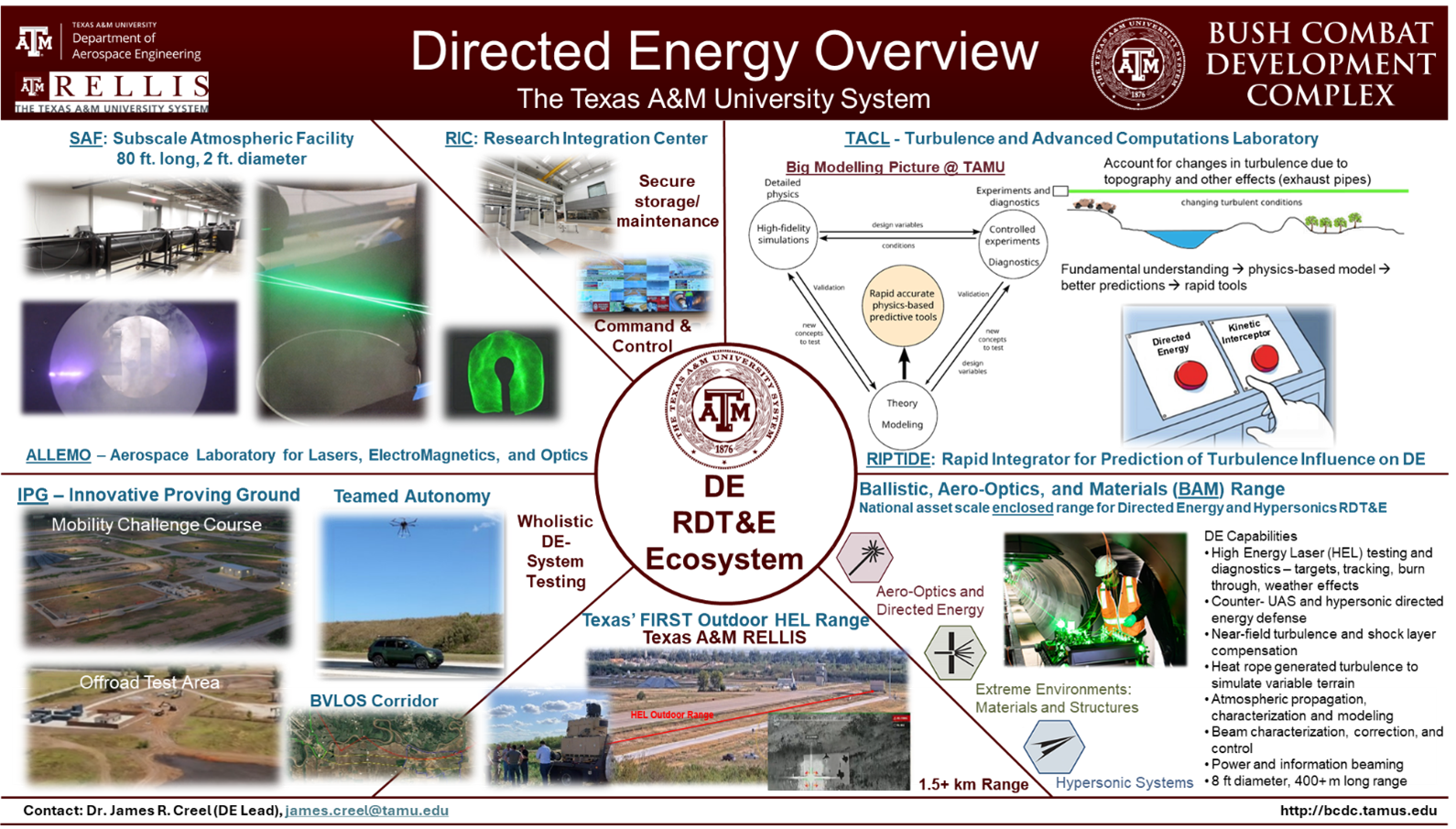
Directed energy (DE) research at the George H.W. Bush Combat Development Complex brings together computational and experimental teams into a fully integrated design and development environment. This effort combines the advanced laser and optics expertise of the Aerospace Laboratory for Lasers, ElectroMagnetics, & Optics (ALLEMO) with high-fidelity modeling and simulation capabilities from the Turbulence & Advanced Computations Lab (TACL). Our work focuses on understanding directed energy effectiveness in turbulent, weather-affected environments such as rain, fog, and crossflows. Experiments are strategically designed to validate computational codes that predict propagation effects in real time.
Laser diagnostics provide a critical bridge between directed energy and hypersonics research, with many techniques overlapping both domains. High-speed diagnostic tools not only capture rapidly varying directed energy laser patterns but also measure key flow parameters in hypersonic facilities and flight environments. These capabilities generate high-fidelity datasets that accelerate model validation and enable the design of next-generation hypersonic systems.
Objective
To advance directed energy and hypersonics research through:
- Integrated computational–experimental development
- Real-time predictive modeling of atmospheric effects
- Laser diagnostics that reveal atmospheric properties and flow physics
Capabilities
Laser Systems
Access to 40+ laser platforms, including: pulse burst lasers, high-power (kW-class) lasers, continuous wave (CW), pulsed (fs, ps, ns) lasers, narrow linewidth lasers and a terawatt femtosecond laser.
Simulation Tools
- Rapid Integrator for Prediction of Turbulence Influence on DE Code (RIPTIDE)
- High-fidelity Modeling of DE propagation through Turbulence
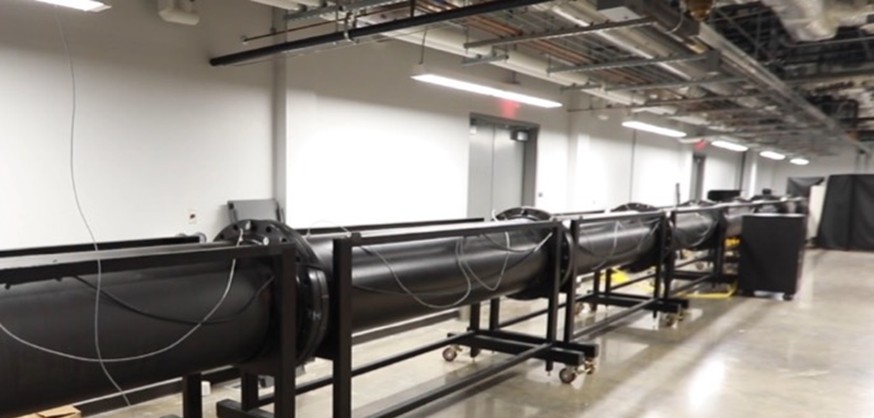
Subscale Atmospheric Facility
A 2′-diameter, 80′-long chamber for DE propagation studies with variable altitude, crossflow, rain, fog, aerosols, and turbulence.
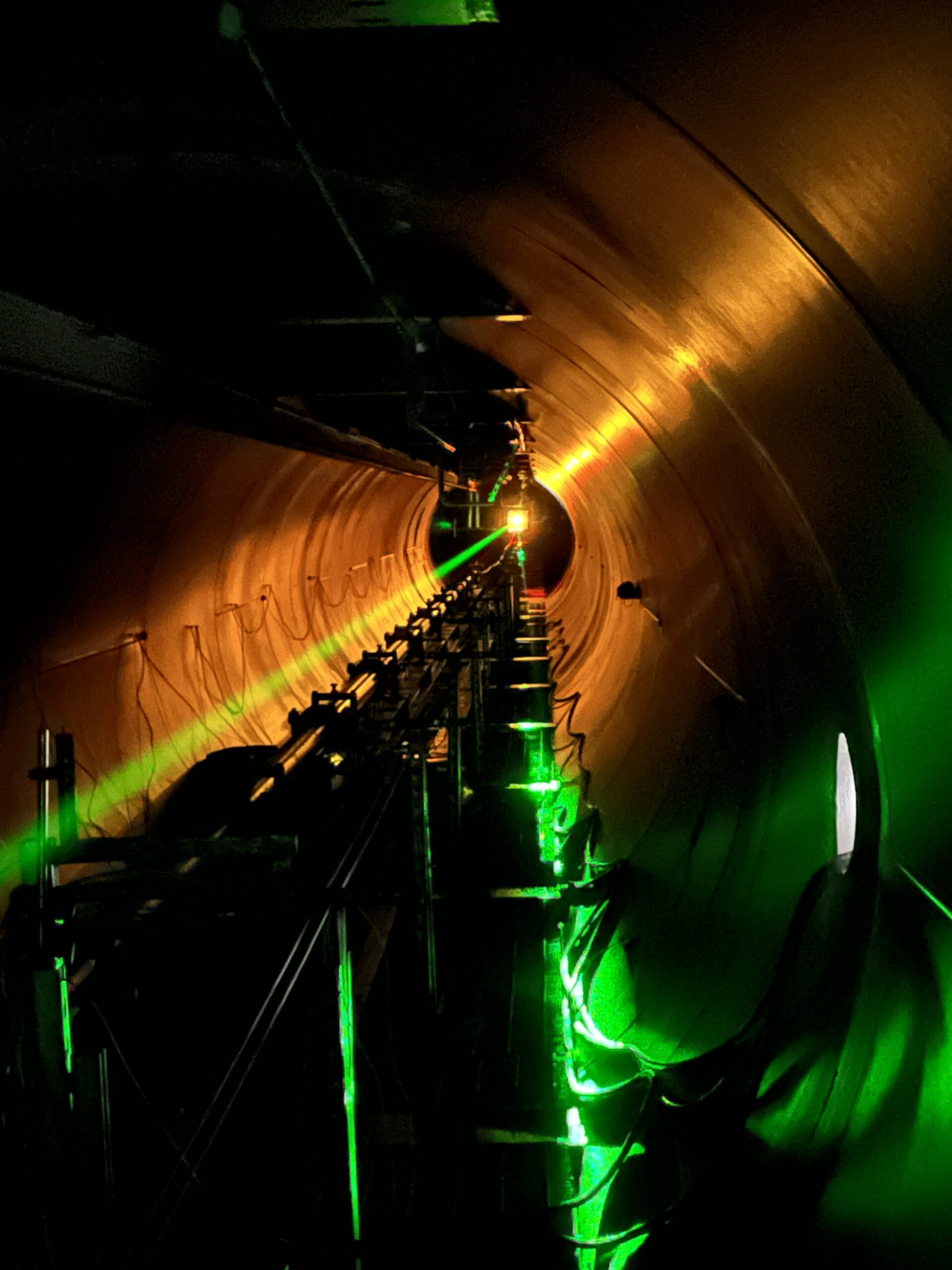
Ballistic, Aero-optics & Materials (BAM) Range
An enclosed 500m test cell with turbulence and weather control for studying DE effectiveness, scintillation, and beam breakup.
Diagnostics
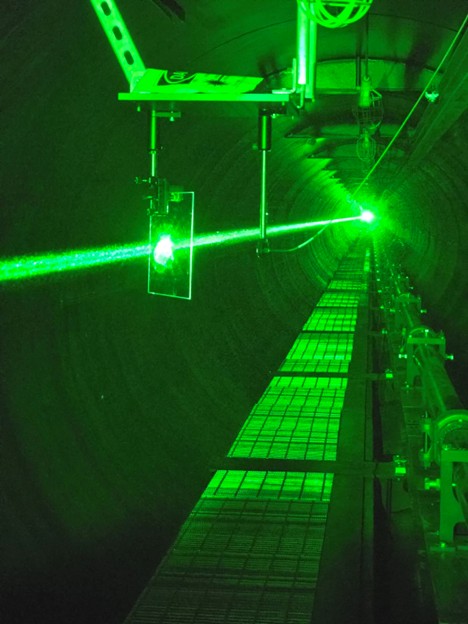
- Fluorescent Imaging Panel (FLIP)
Speckle free imaging of laser scintillation, beam profiles, and beam breakup following propagation through turbulence and weather. (MHz rate capability.) - Nitric-oxide ionization induced Flow Tagging and Imaging (NiiFTI)
Used for measurements of turbulent structure, flow speed and direction in flows containing nitric oxide, either by seeding or by natural nitric oxide formation in high enthalpy environments. (MHz rate capability.) - Femtosecond/Picosecond Coherent Anti-Stokes Raman Scattering (Hybrid CARS)
Used for measurements of rotation and vibrational states of molecular species for the determination of temperature and nonequilibrium conditions. (100kHz rate capability.) - Femtosecond Laser Electronic Excitation Tagging (FLEET)
Used for measurements of turbulent structure, flow speed and direction in air and nitrogen containing flows, (100 kHz capability.) - Slow Light Imaging Spectroscopy (SLIS)
Used for state selected, time gated imaging of Raman and Rayleigh spectral features. (MHz rate capability.) - Filtered Rayleigh Scattering (FRS)
Used to image high speed flow properties including boundary layer motion and shock/boundary layer interactions. (MHz rate capability.) - Planar Laser Induced Fluorescence (PLIF)
Used to image selected molecular species and chemical reactions. (MHz rate capability.) - Femtosecond Two-Photon Absorption Laser Induced Fluorescence (FsTALIF)
Used to image atomic species such as atomic oxygen, hydrogen and nitrogen in high temperature and chemically reacting environments. (100KHz rate capability.) - Volume Bragg Filtered Thomson and Raman Scattering (VBF)
Used to measure molecular gas temperatures and electron densities and temperatures in ionizing environments. (MHz rate capability.) - Vibrationally Excited Nitric Oxide Monitoring (VENOM)
Used for measurements of turbulent structure, flow speed and temperature in flows containing nitric oxide. - MHz Rate Imaging
Imaging up to MHz rates for understanding flow phenomena in hypersonics and beam profiles for directed energy applications (e.g., thermal blooming).